Hilleberg KERON 4 GT | The Ultimate Review

Updated: Mar 30

We titled this review post as 'Hilleberg KERON 4 GT | The Ultimate Review'. After living in it 'FULL TIME' for 16-years we figured it had earned the title.
"Strength - Stability - space and ultimate". The sort of words we all throw around a bit too easily until something actually earns them. This tent has.
The Hilleberg Keron 4 GT has been with us for, well… everything. Sixteen years on the road, 82 countries, six continents, and more questionable camp-spots than I can count. In the middle of Siberia beggars can't be choosers.
At this point it feels odd calling our Keron 4 GT...“gear”. It’s just… home. Slightly dusty, occasionally mud smeared, but always there. Always reliable.
Why This One?
We didn’t stumble into it by accident. There was a slightly obsessive phase beforehand. The kind where you convince yourself spreadsheets about tent specs are perfectly normal behaviour.
Back in 2002, what we wanted didn’t seem to exist. We needed something strong but not ridiculous to carry, roomy but still practical, and capable of handling whatever the world decided to throw at it. Heat, cold, wind, endless rain. The plan, at the time, was about 18 months of travel. Which feels quite funny now.

Finding a tent that ticked all of that off felt a bit like chasing the Holy Grail.
Then along came the Keron 4 GT. Hilleberg’s flagship. A design that had already been around for decades, quietly proving itself while we were still figuring out what “four-season” actually meant.
On paper it sounded spot on. Strong for its weight, generous space, two doors, two vestibules, proper all-season capability. Not marketing fluff, but something that had clearly been tested in the real world.
We bought it in the UK. Full RRP. I remember that part quite clearly. It felt like a lot of money at the time… actually, it still does. But it’s one of those purchases that stops feeling expensive the longer you use it.
Does It Actually Hold Up?
Short answer? Yes.
Long answer… also yes, but with a few more stories attached.
We’ve used this tent pretty much continuously for sixteen years. Deserts, mountains, coastlines, places where the ground is either rock hard or suspiciously boggy. It’s been through conditions that make you question your planning, your sanity, and occasionally your life choices.
And, honestly the Keron 4 GT just gets on with it.

The Kerlon 1800 outer fabric is properly tough. Not “feels durable in the garden” tough, but the kind that holds up when the weather turns and you’re lying there listening to the wind picking at everything. The zips are solid, the stitching hasn’t given up, and the flysheet goes right down to the ground, which makes a massive difference when things get rough. An example: At the freezing end of Patagonia we survived two nights of blasting gust of 74 mph and while the tent moved, flexed and flapped, as it's designed to, it did while protecting us perfectly.
Ventilation is surprisingly good as well, which is crucial in both hot and cold extremes. High vents mean you still get airflow even when everything’s sealed up tight. Useful when you’re dealing with snow, or just trying to avoid waking up in a damp little ecosystem of your own making.
Also, and this is a small thing but I like it, each tent is handmade and signed by the person who built it. There’s something reassuring about that. Feels less like a product, more like something someone actually cared about making.
Also, and this is a small thing but I like it, each tent is handmade and signed by the person who built it.

Space (Because It Matters More Than You Think)
Simon is 6’4”. Or was. He’ll tell you 6’4”, I’ll say closer to 6’3” these days (he lost an inch after his broken neck surgery), but still… tall.
In this tent, he can stretch out properly. No awkward angles, no feet pressing against damp fabric. And even if he does reach the end, the bathtub floor means you’re not getting that lovely cold seep of moisture creeping in.
You’re only ever touching the inner, not the fly. Which, if you’ve ever woken up with wet feet, you’ll appreciate immediately.
The vestibules are brilliant. Two of them, both genuinely usable. Big enough to dump wet kit, cook if you need to, or just sit out bad weather without feeling like you’re trapped in a nylon coffin. And, yes I know you should't cook in a tent and no we're not recommending you do it, but, wen you're trapped in a tent for 5 days in the Himalayas because of mountains storms...well, you still have to eat. With two Kermit chairs set up in the front vestibule, our Dragonfly stove sat in the lid of a pannier lid, I still had room (albeit tight) to prep and cook meals.

When It’s Grim (And It Will Be)
This is where the Keron really proves itself.
It pitches as one piece. Inner and outer together. Which means when you’re putting it up in the rain, the inside stays dry. Completely dry. That’s not a luxury, that’s sanity-saving.
I’ve put this tent up on my own, in the dark, in wind and rain that I would’ve happily avoided. Under five minutes. Not gracefully, not elegantly, but it was up and it worked. On a day to day basis it took us 9 minutes flat, to pull the tent from the bike, get it up and our gear stowed away in place inside it, including inflating the mattresses and pulling out the sleeping bags. Yes, of course we timed it.
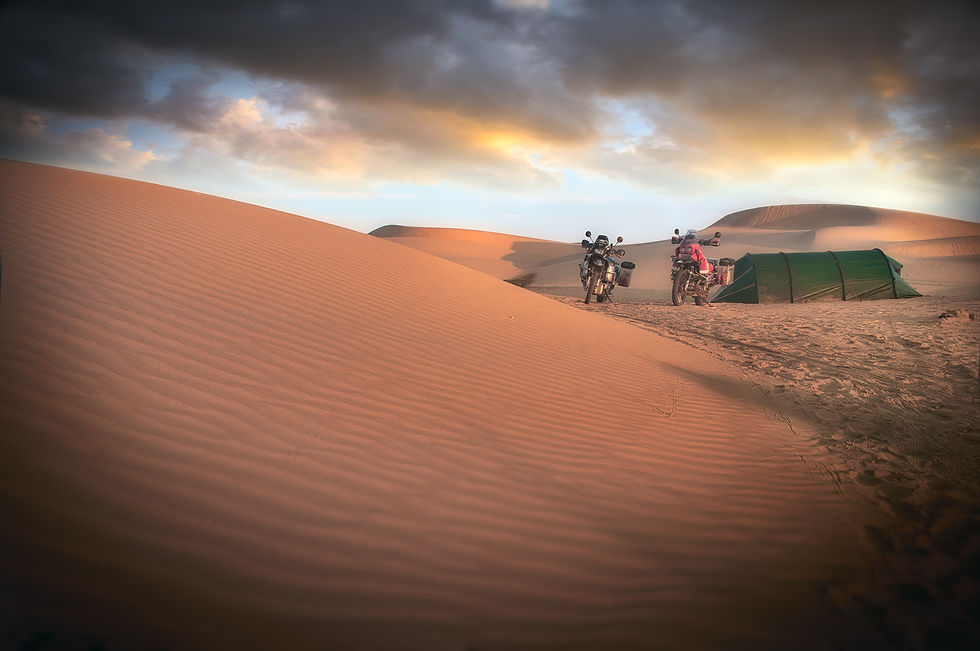
After a long day on the bikes, soaked through and slightly fed up, being able to throw everything into the vestibule and climb straight into a dry sleeping space is… hard to overstate.
We’ve had nights down to -15°C. Winds steady at 60 km/h with gusts pushing 90. The kind where you pause and listen, just to make sure everything’s still where it should be.
It always was.
The Honest Bits
It’s not perfect.
It’s long. You do have to think about where you’re pitching it. Not every spot is going to work, especially if you’re trying to squeeze into tighter spaces. It's also not a geodesic tent, which is a fancy way of saying it's not free-standing. You need a minimum of 6 pegs (3 at each end) to erect the tent because of its accordion like design. In 16-years we've, not once found this to be a problem. Let's be honest, if the weather is so calm and predictable that you only need a freestanding tent without a single peg anchoring it to the ground, then you might as well just roll out your mat and bag and sleep under the stars.
Condensation can happen. Particularly in still conditions. It’s manageable with ventilation, but it’s there.
And yes, it’s expensive. There’s no soft way of saying that. It sits right at the top end of the market.

So… Would We Still Choose It?
We bought this tent expecting it to last a year and a half.
Our first tent lasted 7-years and ended up giving way to the extreme usage asked of it, and the ultraviolet damage done to the outer tent material based on extreme use in some of the hottest places on earth.
The fact that we used it almost 7 days a week for 7 years also left it's mark.
And, if your the curios type, and I know you are because you read to the bottom of this post, then you'll want to know how many Keron 4 GT's we've actually been through...and the answer is three.
At some point along the way it stopped being something we reviewed and just became part of how we live. It’s the sanctuary we relied on without really thinking about it anymore, which is probably the highest compliment you can give any bit of kit.
If you’re looking for something for the odd weekend, the Keron 4 GT is probably overkill.
If you’re heading out properly, for the long haul, into places where your gear actually matters…
This one earns its place. Every single night.

Comments